

Briard
Other Names: Berger Briard, Berger de Brie
Country of Origin: France
Accreditation:
American Kennel Club (AKC): Herding
Canadian Kennel Club (CKC): Herding
United Kennel Club (UKC): Herding Dog
Australian National Kennel Council (ANKC): Working Dogs
The Kennel Club (KC): Pastoral
Kennel Union of Southern Africa (KUSA): Herding
National Kennel Club (NKC): Recognized
New Zealand Kennel Club (NZKC): Working Dogs
- Height:
- Male: 23-27 inches; Female: 22-25½ inches
- Weight:
- Male: 80-90 pounds; Female: 70-80 pounds
- Color(s):
- Black, various shades of gray, and various shades of tawny
- Coat:
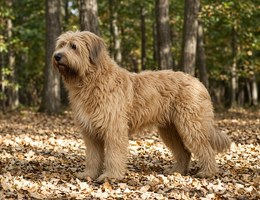
- Double; course, hard and dry, and flat outer coat, falling naturally in long, slightly wavy locks; fine and tight undercoat
- Description:
- The Briard has historically, and still serves, as a herder and flock guardian today, as well as an esteemed companion dog. Some of the Briards talents are search & rescue, police work, military work, herding, watch dogging and guarding.
- Temperament:
- The Briard is a very loyal and protective breed. The Briard has been called "a heart of gold wrapped in fur." Once the Briard has bonded to his family members, they will be very protective. They can be aloof with strangers, and new introductions should be on the dog's terms. They require being shown that the new intrusion is friendly and free of conflict. They must be taught that it is a good thing and not harmful. They have proven to be a very good breed to have around children of all ages.
- Training:
- Socialization needs to start at a very young age. Briards should be walked as often as possible, to many different places, to develop into well-rounded dogs. Pet stores, city parks and malls are good places for socialization. The Briard should be introduced to several different individuals of all ages and in all types of situations. The Briard has been bred for centuries to herd and to protect their flocks. To domesticated briards, their family is the flock and all strangers may appear to be predators. Letting them know that the public in general are friendly and not harmful will help them establish a lifelong socialization pattern which will result in an outgoing and happy dog. This socialization with the public in general will not diminish their capacity for protecting and guarding their family. Note that if the Briard is left alone over an hour or 2 it will become stressed and worried about the flock and it might bite or scratch itself.
- Care & Grooming:
- The Briard’s long coat requires an extensive amount of grooming.
- Shedding:
- Moderate; the long coat holds loose hair and needs regular brushing.
- Health:
- Briards may be prone to hip dysplasia, progressive retinal atrophy, hypothyroidism, and bloat. Eye exams and hip scores should be part of a breeding program.
- Lifespan:
- 10–12 years
- Litter Size:
- 6–10 puppies
Crosses that include the Briard
These hybrid pages list this breed as a parent. Open a name to see the other contributing breed.
Pup.com Copyright © 2007 - 2026 All Rights Reserved
Pup.com accepts no responsibility for the accuracy of the advertisements placed on the Pup.com website or for the contents of any website to which a hypertext link from Pup.com links. The Seller Ads and links to products and/or services are provided as a service, and Pup.com gives no warranties, expressed or implied, about the information and/or policies of the Seller Ads or the linked-to webites, or of the information shown.
Pup.com is the sole owner of the services and of all information provided by and posted to the Pup.com website. The use, reproduction, or storing of content for any purpose other than to contact a Seller, purchase a product or service, or compare prices is prohibited. You cannot use the information provided by Pup.com to recreate a directory, rebrand the informaton or redistribute the information in any way. Information provided by Pup.com is for individual, non-commercial use only. All information, processes and content contained within and that make up the services are the sole property of Pup.com. You may not reproduce, duplicate or redistribute any information provided by Pup.com for profit or personal gain of any kind. You may not frame any content or pages contained within the Pup.com website unless expressly granted permission by Pup.com.