

Golden Retriever
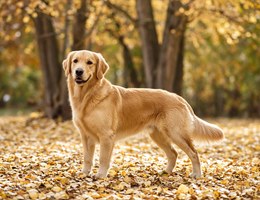
Other Names: Golden, Retriever
Country of Origin: Great Britain
Accreditation:
American Kennel Club (AKC): Sporting
Canadian Kennel Club (CKC): Sporting
United Kennel Club (UKC): Gun Dog
Australian National Kennel Council (ANKC): Gun Dogs
The Kennel Club (KC): Gun Dogs
Kennel Union of Southern Africa (KUSA): Gun Dogs
National Kennel Club (NKC): Recognized
New Zealand Kennel Club (NZKC): Gun Dogs
- Height:
- Male: 22-24 inches; Female: 20-22½ inches
- Weight:
- Male: 60-80 pounds; Female: 55-70 pounds
- Color(s):
- A variety of colors, including any shade of gold or cream
- Coat:
- Dense, water repellent, with moderate feathering
- Description:
- The Golden Retriever originates from a mix of the Tween Water Spaniel, which is now extinct, the Red Setter, and the Wavy-Coated Retriever. Goldens were developed as gundogs to retrieve shot waterfowl and upland game during hunting, and as such, they were bred to have a soft mouth to retrieve game undamaged, and to have an instinctive love of water. Their intelligence and versatility sees them employed in a variety of roles including illegal drug detection, Search and Rescue, as hunting dogs, and as guide dogs.
- Temperament:
- The Golden Retriever’s friendly, eager-to-please, and patient demeanor has made him one of the most popular family dogs, by registration, in the world today. The typical Golden Retriever is calm, naturally intelligent, with an exceptional eagerness to please. He is renowned for his patience with children, and he is good with other dogs, cats, and most livestock. He is active and fun-loving animal, who also enjoys sitting quietly for hours. Some dogs may be too active to be easily exercised by elderly owners. Golden Retrievers become very attached to their owners, and leaving them alone for extended periods can cause the dog to become very sad and distressed. Goldens have a trusting, gentle disposition with both strangers and their family, which makes them poor guard dogs. As the name suggests, the Golden Retriever loves to retrieve. Whether the object is a thrown stick, tennis ball, or flying disc, retrieving can keep the Golden occupied and entertained for hours, particularly if water is involved. They often like to have something in their mouth, and will carry things around. The Golden Retriever loves to work, and has a keen ability to focus on a given task. Goldens have also been known to become excellent surrogate mothers to different species. Kittens, and even tiger cubs from zoos, have been well-cared for by Golden Retrievers. In some cases, a Golden may even produce milk for its adopted orphan, even though it may not have been pregnant or nursing recently.
- Training:
- Due to their intelligence, athleticism, and desire to please their handlers, Golden Retrievers are exceptionally trainable. Golden Retrievers respond well to positive and upbeat training styles, and harsh training methods are unnecessary. Goldens can learn up to roughly 240 commands, words and phrases.
- Care & Grooming:
- Most Goldens need plenty of exercise, such as daily walks and dog agility. They are a breed that is prone to obesity, and care must be taken to balance diet and exercise. When given a task to do, a Golden Retriever will seemingly work until collapse, so care should be taken to avoid overworking them. Goldens should be groomed at least once a week, and every day during heavy shedding. They also need to have their ears cleaned regularly to avoid an ear infection.
- Shedding:
- Moderate to heavy; the water-repellent coat sheds more in spring and fall.
- Health:
- Golden Retrievers have a high rate of cancer and may also develop hip and elbow dysplasia, heart disease, and eye problems. Choose breeders who screen hips, elbows, heart, and eyes.
- Lifespan:
- 10–12 years
- Litter Size:
- 6–8 puppies
Crosses that include the Golden Retriever
These hybrid pages list this breed as a parent. Open a name to see the other contributing breed.
Pup.com Copyright © 2007 - 2026 All Rights Reserved
Pup.com accepts no responsibility for the accuracy of the advertisements placed on the Pup.com website or for the contents of any website to which a hypertext link from Pup.com links. The Seller Ads and links to products and/or services are provided as a service, and Pup.com gives no warranties, expressed or implied, about the information and/or policies of the Seller Ads or the linked-to webites, or of the information shown.
Pup.com is the sole owner of the services and of all information provided by and posted to the Pup.com website. The use, reproduction, or storing of content for any purpose other than to contact a Seller, purchase a product or service, or compare prices is prohibited. You cannot use the information provided by Pup.com to recreate a directory, rebrand the informaton or redistribute the information in any way. Information provided by Pup.com is for individual, non-commercial use only. All information, processes and content contained within and that make up the services are the sole property of Pup.com. You may not reproduce, duplicate or redistribute any information provided by Pup.com for profit or personal gain of any kind. You may not frame any content or pages contained within the Pup.com website unless expressly granted permission by Pup.com.