

Great Pyrenees
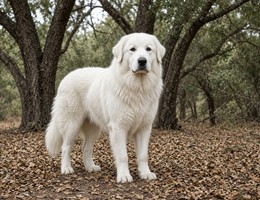
Other Names: Pyrenean Mountain Dog, Chien des Pyrénées, Chien de Montagne des Pyrénées, Montañés del Pirineo
Country of Origin: France and Spain
Accreditation:
American Kennel Club (AKC): Working
Canadian Kennel Club (CKC): Working
United Kennel Club (UKC): Guardian Dog
National Kennel Club (NKC): Recognized
- Height:
- Male: 27-32 inches; Female: 25-29 inches
- Weight:
- Male: 110-120 pounds; Female: 80-90 pounds
- Color(s):
- White, and may have varying shades of gray, red (rust), or tan around the face
- Coat:
- Double; dense; fairly long and flat topcoat; very thick, fine and wooly trouser hair
- Description:
- The Great Pyrenees is a very old breed, descended from the ancient Tibetan Mastiff, and, more recently, from their descendants, the Mollossian Hounds brought to Spain by the Romans. The Great Pyrenees has been used for millennia by shepherds, which includes Basque people, who inhabit parts of the region in and around the Pyrenees Mountains of southern France and northern Spain. More recently, the breed served as the official dog of the royal French court, whose prominence began circa the Middle Ages, and lasted until the middle of the nineteenth century. During World War II, the dogs were used to haul artillery over the Pyrenean Mountain range to and from Spain and France. They are related to several other large white European livestock guardian dogs, including the Italian Maremma Sheepdog, Kuvasz, Akbash Dog, and Tatra Shepherd Dog.
- Temperament:
- The Great Pyrenees has an innate gentleness, and becomes very attached to his "flock". He has a propensity for independence, and a sense of authority, having been left on his own to protect his flock.
- Training:
- Socialize early and keep the rules quiet and firm. This livestock guardian was selected to think for itself.
- Care & Grooming:
- Brush the heavy white coat weekly, more often when the undercoat blows.
- Shedding:
- Seasonal and heavy; the dense white coat blows large amounts of undercoat.
- Health:
- Great Pyrenees may develop hip dysplasia, eyelid problems, Addison’s disease, and bloat. Keep this guardian lean and watch for overheating under the heavy coat.
- Lifespan:
- 10–12 years
- Litter Size:
- 6–10 puppies
Crosses that include the Great Pyrenees
These hybrid pages list this breed as a parent. Open a name to see the other contributing breed.
Pup.com Copyright © 2007 - 2026 All Rights Reserved
Pup.com accepts no responsibility for the accuracy of the advertisements placed on the Pup.com website or for the contents of any website to which a hypertext link from Pup.com links. The Seller Ads and links to products and/or services are provided as a service, and Pup.com gives no warranties, expressed or implied, about the information and/or policies of the Seller Ads or the linked-to webites, or of the information shown.
Pup.com is the sole owner of the services and of all information provided by and posted to the Pup.com website. The use, reproduction, or storing of content for any purpose other than to contact a Seller, purchase a product or service, or compare prices is prohibited. You cannot use the information provided by Pup.com to recreate a directory, rebrand the informaton or redistribute the information in any way. Information provided by Pup.com is for individual, non-commercial use only. All information, processes and content contained within and that make up the services are the sole property of Pup.com. You may not reproduce, duplicate or redistribute any information provided by Pup.com for profit or personal gain of any kind. You may not frame any content or pages contained within the Pup.com website unless expressly granted permission by Pup.com.