

Harrier
Other Names:
Country of Origin: England
Accreditation:
American Kennel Club (AKC): Hound
Canadian Kennel Club (CKC): Hounds
United Kennel Club (UKC): Scenthound
Australian National Kennel Council (ANKC): Hounds
New Zealand Kennel Club (NZKC): Hound
- Height:
- 19-22 inches
- Weight:
- 40-60 pounds
- Color(s):
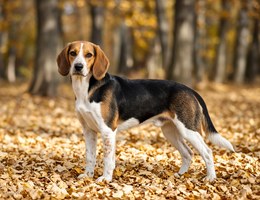
- Usually black, tan and white, but can be of any hound colors
- Coat:
- Short, hard, dense, glossy; weatherproof
- Description:
- The Harrier was developed in England to hunt hare in packs, and has been used in America for hunting since Colonial times. Although the origin of the Harrier is not known for sure, one theory is that the breed is simply a smaller version of the English Foxhound, bred down from the larger breed through selective breeding. Another theory is that the earliest Harrier types were crossed with Bloodhounds, the Talbot Hound, and even the Basset Hound. And, yet another theory is that the breed developed from crosses of the English Foxhound with Fox Terrier and Greyhound. The Harrier is still fairly rare in the United States, but has a long history of popularity as a working pack dog in England.
- Temperament:
- The Harrier is outgoing, cheerful, sweet-tempered, tolerant, and excellent with children. As a pack dog, he is good with other dogs. He prefers life in a pack with people, dogs, or both. Due to his strong prey drive, he should be supervised with non-canine pets unless he is raised with them from puppyhood. He is an active dog that likes to go exploring, sniffing, and trailing. Some Harriers like to bay.
- Training:
- As all hound dogs, the Harrier tends to be ruled by his nose, with a strong tracking instinct, which can make him appear to be independent, willful, vocal and somewhat stubborn. Early training will help the Harrier to follow the leadership of his human pack leader.
- Care & Grooming:
- The Harrier requires very little grooming. An occasional brushing or combing to remove dead hairs is sufficient. He only requires a bath when dirty or smelly. His ears should be cleaned periodically and checked for ear mites. He enjoys food, and has a tendency to overeat, which can make him fat. The Harrier requires daily exercise, such as long vigorous walks or runs. He also enjoys playing in open space, which should be enclosed and safe, as he tends to follow his nose and it could lead him into trouble. Without appropriate exercise, the Harrier can become hyperactive, overweight and/or destructive.
- Shedding:
- Low to moderate.
- Health:
- Harriers are typically hardy pack hounds. Ear infections and hip dysplasia can occur; they do best with daily work and a lean body weight.
- Lifespan:
- 12–15 years
- Litter Size:
- 5–8 puppies
Pup.com Copyright © 2007 - 2026 All Rights Reserved
Pup.com accepts no responsibility for the accuracy of the advertisements placed on the Pup.com website or for the contents of any website to which a hypertext link from Pup.com links. The Seller Ads and links to products and/or services are provided as a service, and Pup.com gives no warranties, expressed or implied, about the information and/or policies of the Seller Ads or the linked-to webites, or of the information shown.
Pup.com is the sole owner of the services and of all information provided by and posted to the Pup.com website. The use, reproduction, or storing of content for any purpose other than to contact a Seller, purchase a product or service, or compare prices is prohibited. You cannot use the information provided by Pup.com to recreate a directory, rebrand the informaton or redistribute the information in any way. Information provided by Pup.com is for individual, non-commercial use only. All information, processes and content contained within and that make up the services are the sole property of Pup.com. You may not reproduce, duplicate or redistribute any information provided by Pup.com for profit or personal gain of any kind. You may not frame any content or pages contained within the Pup.com website unless expressly granted permission by Pup.com.