

Newfoundland
Other Names: Newfie, Newf
Country of Origin: Newfoundland (pre-confederation with Canada)
Accreditation:
American Kennel Club (AKC): Working
Canadian Kennel Club (CKC): Working
United Kennel Club (UKC): Guardian Dog
Australian National Kennel Council (ANKC): Utility
The Kennel Club (KC): Working Dogs
Kennel Union of Southern Africa (KUSA): Working Dogs
National Kennel Club (NKC): Recognized
New Zealand Kennel Club (NZKC): Utility
- Height:
- Male: 28 inches; Female: 26 inches
- Weight:
- Male: 130-150 pounds; Female: 120-140 pounds
- Color(s):
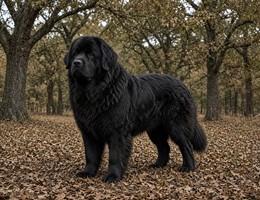
- Black, brown, gray, or landseer (black head and white and black body)
- Coat:
- Thick and straight
- Description:
- The Newfoundland originated in Newfoundland from a breed indigenous to the island. It is likely that his size resulted from the introduction of large mastiffs, brought to the island by many generations of Portuguese fishermen. He was originally used as a working dog, to pull fishnets and heavy equipment. The Newfoundland excels at water rescue, due partly to his webbed feet and amazing swimming abilities. The largest Newfoundland on record weighed 260 pounds, and measured over 6 feet from nose to tail.
- Temperament:
- The Newfoundland is known for his sweet disposition and loyalty, often being referred to as the "gentle giant". He is extremely laid-back and good with children. He has a deep bark, and is a fine guardian and watchdog.
- Training:
- The Newfoundland is easy to train, and are considered easy to housebreak.
- Care & Grooming:
- Newfoundland dogs require grooming at least once every two weeks.
- Shedding:
- Seasonal and heavy; the water-resistant coat blows a thick undercoat.
- Health:
- Newfoundlands may develop hip and elbow dysplasia, heart disease (especially subvalvular aortic stenosis), and cystinuria. Heart and joint screening of breeding stock is important.
- Lifespan:
- 8–10 years
- Litter Size:
- 4–10 puppies
Crosses that include the Newfoundland
These hybrid pages list this breed as a parent. Open a name to see the other contributing breed.
Pup.com Copyright © 2007 - 2026 All Rights Reserved
Pup.com accepts no responsibility for the accuracy of the advertisements placed on the Pup.com website or for the contents of any website to which a hypertext link from Pup.com links. The Seller Ads and links to products and/or services are provided as a service, and Pup.com gives no warranties, expressed or implied, about the information and/or policies of the Seller Ads or the linked-to webites, or of the information shown.
Pup.com is the sole owner of the services and of all information provided by and posted to the Pup.com website. The use, reproduction, or storing of content for any purpose other than to contact a Seller, purchase a product or service, or compare prices is prohibited. You cannot use the information provided by Pup.com to recreate a directory, rebrand the informaton or redistribute the information in any way. Information provided by Pup.com is for individual, non-commercial use only. All information, processes and content contained within and that make up the services are the sole property of Pup.com. You may not reproduce, duplicate or redistribute any information provided by Pup.com for profit or personal gain of any kind. You may not frame any content or pages contained within the Pup.com website unless expressly granted permission by Pup.com.