

Samoyed
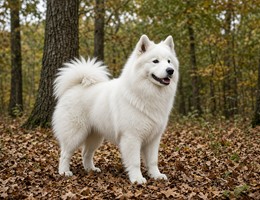
Other Names: Smiley, Smiling Sammy, Sammy, Sam
Country of Origin: Russia (Northwest and Western Siberia)
Accreditation:
American Kennel Club (AKC): Working
Canadian Kennel Club (CKC): Working
United Kennel Club (UKC): Northern Breed
Australian National Kennel Council (ANKC): Utility
The Kennel Club (KC): Pastoral
Kennel Union of Southern Africa (KUSA): Herding
National Kennel Club (NKC): Recognized
New Zealand Kennel Club (NZKC): Utility
- Height:
- Male: 21-23½ inches; Female: 19-12 inches
- Weight:
- Male: 44-65 pounds; Female: 37-55 pounds
- Color(s):
- White, or biscuit
- Coat:
- Double; long, coarse, and straight outer coat; dense, soft, short undercoat
- Description:
- The Samoyed dog takes its name from the Samoyedic peoples of Siberia. These nomadic reindeer herders bred the fluffy, white, smiling dogs to help with the herding, to pull sleds when they moved, and to keep their owners warm at night by sleeping on top of them. Today, Samoyeds are very rarely used for everyday herding work on farms, as breeds with higher herding drives such as Border Collies or Australian Shepherds are more practical to use for this job. Many Samoyeds however, do retain the herding instinct, and occasionally have been used to herd sheep, goats, ducks, and small children competitively and recreationally. Shed Samoyed fur is sometimes used as an alternative to wool in knitting, with hypoallergenic properties and a texture similar to angora. The fur is sometimes also used for the creation of flys for fly fishing. An interesting characteristic of the breed is that these dogs have virtually no smell or "doggy odor" about them, making them especially well-suited to living indoors.
- Temperament:
- Samoyeds are excellent companions, especially for small children or even other dogs. They instinctively act as herd dogs, and when playing with children, especially, they will often attempt to move them in a different direction. Samoyeds have a lot of vitality, and well cared for Samoyeds are known to retain their youthful, energetic spirit well into their senior years. The Samoyed’s friendly disposition makes him a poor guard dog; however, with his tendency to bark, he can be a diligent watch dog, barking whenever something approaches his territory. In cold weather, it is not unusual to see a Samoyeds sleeping with his tail over his nose for added warmth.
- Training:
- A Samoyed is not averse to pulling things, and an untrained Samoyed has no problem pulling his owner on a leash, rather than walking alongside.
- Care & Grooming:
- The Samoyed has excellent stamina, and without daily exercise, he will become bored and/or depressed, which can lead to excessive barking, destruction, weight gain, irritability, and escape-artist behavior. His dense coat can make summer temperatures uncomfortable for him in very warm climates, and he prefers to be indoors where the air is cooled. The Samoyed requires weekly brushing to avoid matting. He may occasionally need the fur between his paw pads trimmed, but otherwise his coat does not need to be clipped. Unless medically necessary, it is not recommended to shave a Samoyed’s fur, as the coat acts as an insulator against both cold and moderate heat, and protects his light-colored skin from sunburn. His coat also acts as a natural repellent to fleas and ticks. The Samoyed is typically very good about grooming himself, and his bathing needs are minimal. Dirt typically falls from his outer layer of fur with little work, making him deceptively easy to keep very clean looking. Giving a Samoyed a bath is a somewhat time consuming process, as his coat is semi-weatherproof, and will take some time to get completely wet, then completely rinsed. It is important to rinse well, as any shampoo or soap left in the coat can cause irritation or a fungal infection, which is difficult to cure without shaving the affected location. The Samoyed’s coat should be dried with cool, forced air, as water can be trapped in the very thick undercoat, has difficulty evaporating, and may remain in the fur for some time, possibly creating irritation. Drying the coat will also reduce matting caused by dampness in the undercoat. Cool, forced-air drying can be done with a canister dryer, shop vacuum, or blow or kennel dryer.
- Shedding:
- Seasonal and heavy; the white stand-off coat blows large amounts of undercoat.
- Health:
- Samoyeds may develop hip dysplasia, progressive retinal atrophy, and Samoyed hereditary glomerulopathy (a kidney disease). Ask breeders about hip, eye, and kidney testing.
- Lifespan:
- 12–14 years
- Litter Size:
- 4–8 puppies
Crosses that include the Samoyed
These hybrid pages list this breed as a parent. Open a name to see the other contributing breed.
Pup.com Copyright © 2007 - 2026 All Rights Reserved
Pup.com accepts no responsibility for the accuracy of the advertisements placed on the Pup.com website or for the contents of any website to which a hypertext link from Pup.com links. The Seller Ads and links to products and/or services are provided as a service, and Pup.com gives no warranties, expressed or implied, about the information and/or policies of the Seller Ads or the linked-to webites, or of the information shown.
Pup.com is the sole owner of the services and of all information provided by and posted to the Pup.com website. The use, reproduction, or storing of content for any purpose other than to contact a Seller, purchase a product or service, or compare prices is prohibited. You cannot use the information provided by Pup.com to recreate a directory, rebrand the informaton or redistribute the information in any way. Information provided by Pup.com is for individual, non-commercial use only. All information, processes and content contained within and that make up the services are the sole property of Pup.com. You may not reproduce, duplicate or redistribute any information provided by Pup.com for profit or personal gain of any kind. You may not frame any content or pages contained within the Pup.com website unless expressly granted permission by Pup.com.